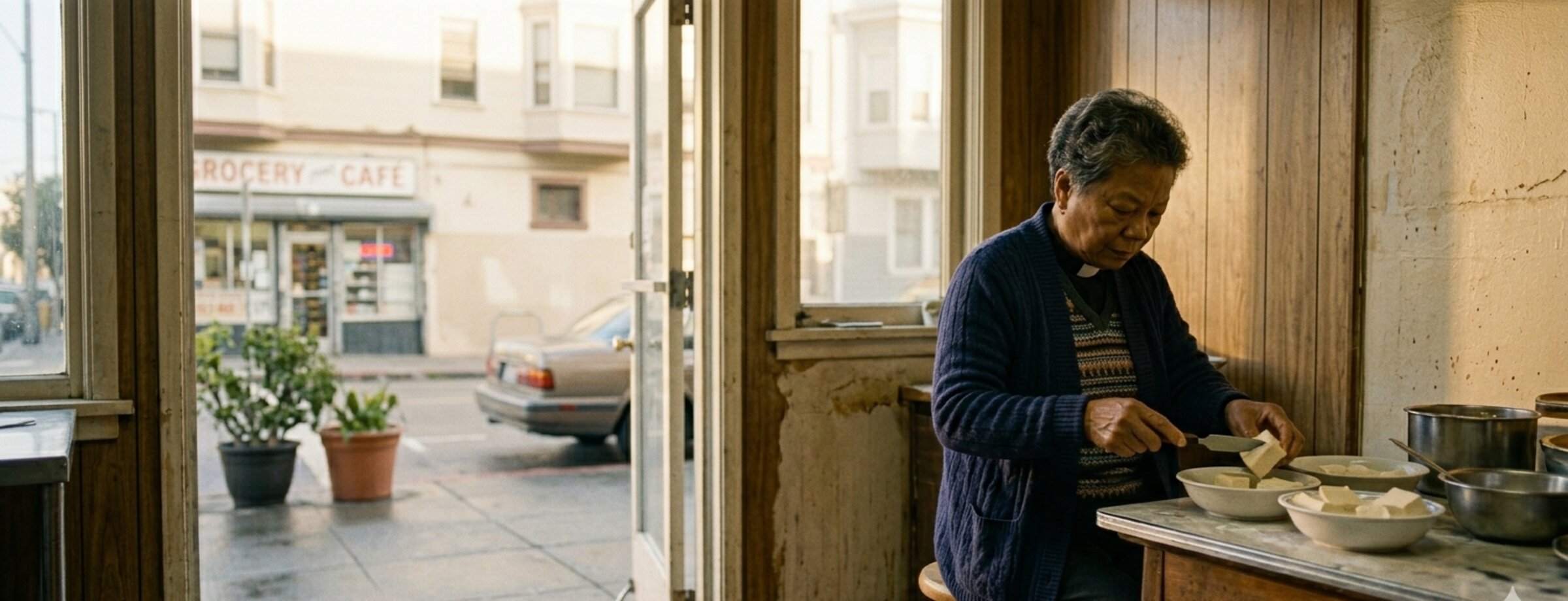
It is 5:48 in the morning on a Tuesday in February when Mrs. Kim flips the switch on a tofu press she bought in 1992 and slides the first batch out. The press is heavy. She is 67. She uses both hands.
The shop is on Geary Street, between a vape store that opened last year and a bubble tea chain that opened the year before that. The block has changed around her. The shop has not. The hand-painted sign her husband made in 1989 still says Soon Dubu House in white block letters on a red background. The paint is chipping at the bottom corner where rain reaches.
Mrs. Kim, 67, was born in Busan in 1958. She came to San Francisco in 1991 with her husband and a daughter. Her husband had a brother in Daly City. They lived above the brother’s garage for fourteen months. The shop opened in October 1992 with three tables.
The soybeans she uses come from a farm in Stanislaus County, the same farm she has bought from for 22 years. They arrive on a pallet on Mondays. She soaks them overnight. By 4:30 a.m. Tuesday she is grinding. By 5 a.m. she is heating the soy milk. By 5:30 the curds are forming. By 5:48 the press is doing its work.
The first bowl of soondubu of the day is for the dishwasher. He arrives at 6 a.m. His name is Carlos. He is from Guatemala. He has worked here since 2018. He eats the same thing every morning, sitting at the small table behind the counter. Soondubu, no spice, extra rice. Mrs. Kim makes it for him. He never says thank you because he never has to.
“My customers come because they remember their mothers,” she says, in Korean. She switches to English. “I am not making tofu. I am making memory.” She switches back to Korean. “But the tofu has to be good or the memory is wrong.”
Her husband died in 2003 of liver cancer. He was 58. The shop closed for two weeks. Mrs. Kim says she does not remember those two weeks. Her daughter, who was 18 and starting at Cal, drove back to San Francisco and reopened the shop with her on a Tuesday morning. They served eleven customers. Two of them were people her husband had known.
“I told my daughter, you go back to school. I told her, this is mine now. I will do it.” Her daughter is 41 now and lives in Seattle. She visits twice a year. They speak on Sundays.
A bowl of soondubu at the shop costs $14.95. In 1992 it cost $4.95. She raised the price in 1996 to $5.95, in 2003 to $7.95, in 2010 to $9.95, in 2017 to $12.95, in 2023 to $14.95. Each raise was for a specific reason. The 2003 raise paid for her husband’s medical bills. The 2017 raise paid for a new ventilation hood the city required. The 2023 raise was for her own knees.
She points at a table by the window. “That girl, she came here when she was three years old. Her mother brought her. Now she brings her own kid. Three generations at one table, eating the same tofu I made.” The girl is named Hannah. She is 32. Her daughter is two and a half. They come every other Saturday at 11 a.m.
The notebook from under the register is a black leather Moleskine. The first phone numbers are from 1995. There are 412 entries. Some are crossed out. Some are circled. The circled ones are people she calls if she does not see them for a month.
Last year she circled Mrs. Lee. Mrs. Lee is 84 and lives alone in the Outer Richmond. Her husband died in 2019. She used to come every Friday for ten years. In November 2025 she missed a Friday. Mrs. Kim called. Mrs. Lee had fallen and broken her hip. She was in the hospital for three weeks. When she got out, Mrs. Kim drove to her apartment with two stone pots of soondubu. Mrs. Lee called her three days later to say it was the best food she had eaten since the hospital.
“I know everyone on this block who has been here more than ten years,” Mrs. Kim says. “Ten years is the cutoff. That is when I trust them.” On her side of the street, four businesses qualify: the dry cleaner, the optometrist, the Korean Methodist church (which is a building, not a business, but counts), and her shop. The vape store next door is in its third tenant in five years. The bubble tea shop is in its second.
Three other Korean tofu houses have closed in San Francisco since 2018. Lim’s Soondubu on Balboa closed in 2019. The Korean Tofu House on Clement closed in 2021. Manna’s, on Irving, closed in 2024. Mrs. Kim went to all three closing nights. She brought rice cakes. She did not stay long.
“I am the last one in the city now,” she says. She does not say this with pride. She says it the way someone might say it is raining.
By 6:30 the lights are on at the bubble tea chain. By 7:00 three regulars are waiting at her door. She unlocks it without saying anything. They walk in like it is their kitchen. The first one is Mr. Park, retired, 71. He has been coming on Tuesdays since 1998. He sits at the counter. He does not look at a menu. He does not look at his phone. He waits, watching the steam.
Mr. Park’s wife died in 2021. He started coming on Saturdays after that. Then Saturdays and Tuesdays. Mrs. Kim has not asked him why. She knows.
She makes him a bowl. She brings it to him with both hands and sets it down with the right hand. The Korean word for this kind of placing, she says, is gongyeong. Respect for the food and the eater at the same time. She learned it from her mother. Her mother died in 1989. She learned it because her mother said you can serve a soup wrong, and the soup will be lonely.
Mr. Park bows his head to the bowl, blows on the surface, takes one careful spoon. He nods, twice. He does not speak. Mrs. Kim is already back in the kitchen. The steam from his pot clouds the front window. Outside, a delivery truck for the bubble tea shop is double-parked and the driver has gone inside for water.
Mrs. Kim returns to the press. She pulls the lever. The drum tilts. A wave of fresh tofu rolls onto the cooling tray. Her hands are wet. The fan spins up. The smell shifts, sweet, almost sticky. Mr. Park’s cup of barley tea steams beside his bowl.
She wipes the back of her wrist across her forehead. Her hair is gray now and held back with a scrunchie that has been in her right pocket every Tuesday morning for nine years. She picks up the ladle. She smiles, not at anyone in particular, the way you might smile at a younger sibling who is eating well.


