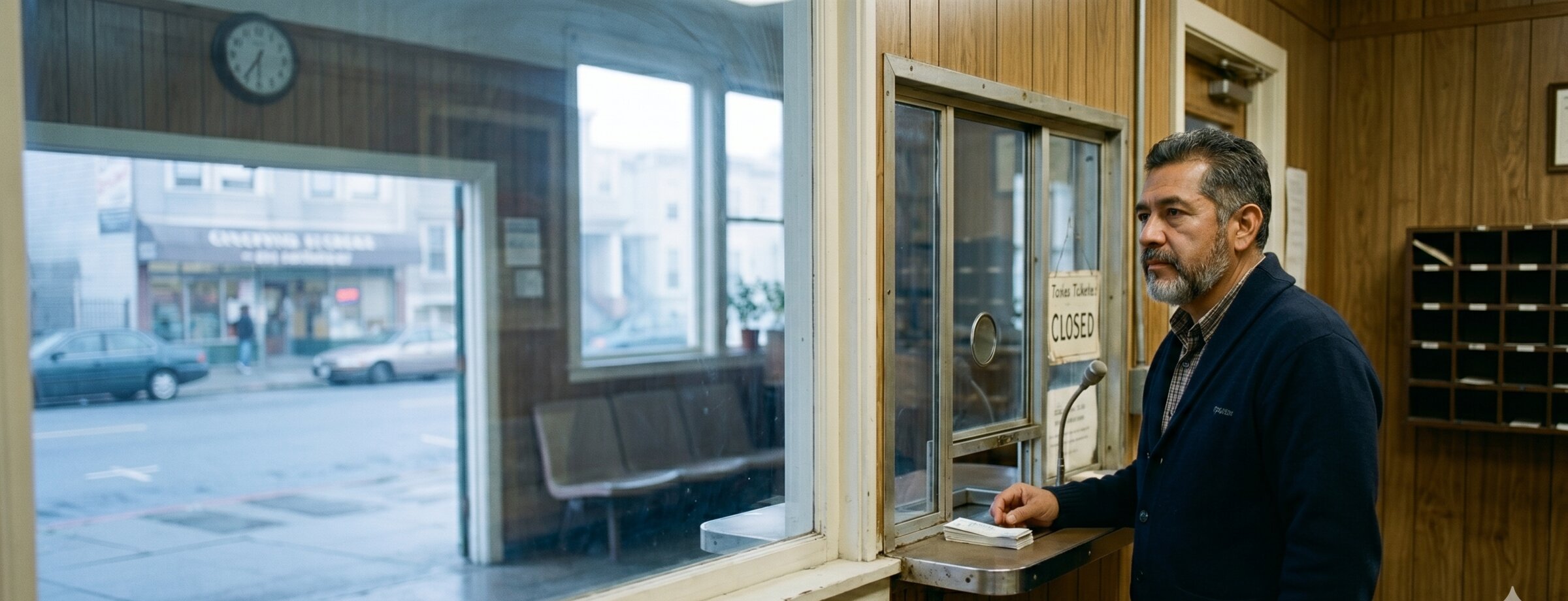
On Clement Street, between 21st and 22nd Avenues, in a storefront the size of a one-car garage, Mei Lin Wong runs a letterpress shop called Lin Printing. The window says PRINTING in English and 印刷 in Chinese. There is no other signage.
She prints memorial cards. Almost exclusively. About 600 funerals worth a year. Roughly 11,000 funerals in 19 years. Almost every Chinese American funeral in San Francisco runs through her press at some point in the week before the service.
The cards are printed on a 1958 Heidelberg Windmill that Mei Lin’s father, Mr. Lin, brought from Hong Kong in 1971. Mr. Lin printed wedding invitations and business cards on the same press for 36 years. He died in 2007. Mei Lin took over the shop the next month. She switched the inventory to memorial cards because, she says, the city had three printers doing weddings and only her father doing memorials.
A Chinese memorial card is small. About the size of a closed passport. The front has a photograph of the deceased, usually one the family has chosen and provided. Mei Lin scans it, retouches it (mostly removing dust spots and brightening the eyes), and prints a half-tone version onto matte cardstock. The back has the name in Chinese and English, the dates, the location of the service, and a four-character classical Chinese phrase chosen by the family.
The phrase is the most fraught part. Mei Lin keeps a list of about 400 phrases on a sheet of paper next to the press. Families consult it when they do not have a phrase already chosen. About a third of the families do not have one chosen. Mei Lin sits with them in the front of the shop, makes them tea, and walks them through the list. The conversation takes between fifteen minutes and two hours.
“The phrase is what the dead person told you, by how they lived,” she says. “If the family knows the dead person, they know the phrase. If the family is in shock and cannot remember, that is what I am there for.”
Mei Lin has, in 19 years, lost zero names. She keeps a paper ledger of every job, organized by the date of the funeral. The ledger is in a fireproof safe in the back of the shop. She has scans of every photograph she has ever printed, organized by year, on three external hard drives kept at three different addresses.
In 2019, a family came back to her in tears. They had thrown out the only photograph of their grandmother during a move. The funeral had been in 2008. Mei Lin found the scan in her archive in nine minutes. She printed twelve new copies of the card on the original cardstock. She did not charge them. She has done this, she says, about thirty times.
A regular memorial card order is 100 cards for $90. Some families order 50; some order 300. Mei Lin charges by quantity, not difficulty. She does not charge extra for revisions. She does not charge a rush fee. She works seven days a week, in volumes that fluctuate with how many people in the city died last week.
In 2020, the year of the pandemic, she printed cards for 1,847 funerals. The ledger from that year is twice as thick as a normal year’s. She does not like to talk about it. She will say only that she ran out of black ink twice and that the second time the ink supplier in San Bruno drove the can over personally on a Sunday morning.
On the Wednesday I visited, Mei Lin was setting type for three funerals: a 91-year-old man from the Sunset, a 47-year-old mother from the Excelsior, and an infant who had been born too early at UCSF. The three jobs would be printed in order of funeral date. The infant’s service was on Saturday. Mei Lin’s eyes did not stop moving while she set the type. She does not cry while she works. She cries on Sundays, sometimes, in her apartment two blocks away.
When the press starts up it makes a particular sound, a slow chock-chock-chock at about 60 beats a minute. Mei Lin says she has not heard silence in nineteen years. She has gotten used to it. She would not know how to live without it.