
Twenty-four years, fourteen thousand kids, the same five rules on the wall. The current program director has held the room together by refusing to let it grow.
IN COLLABORATION WITH 826 VALENCIA
ISSUE №55 · MAY 16, 2026 · 4-MIN READ
THE TUTOR ROOM AT 826 VALENCIA THAT HAS BEEN OPEN SINCE 2002
BY DAISY · PHOTOGRAPHS BY KIWI
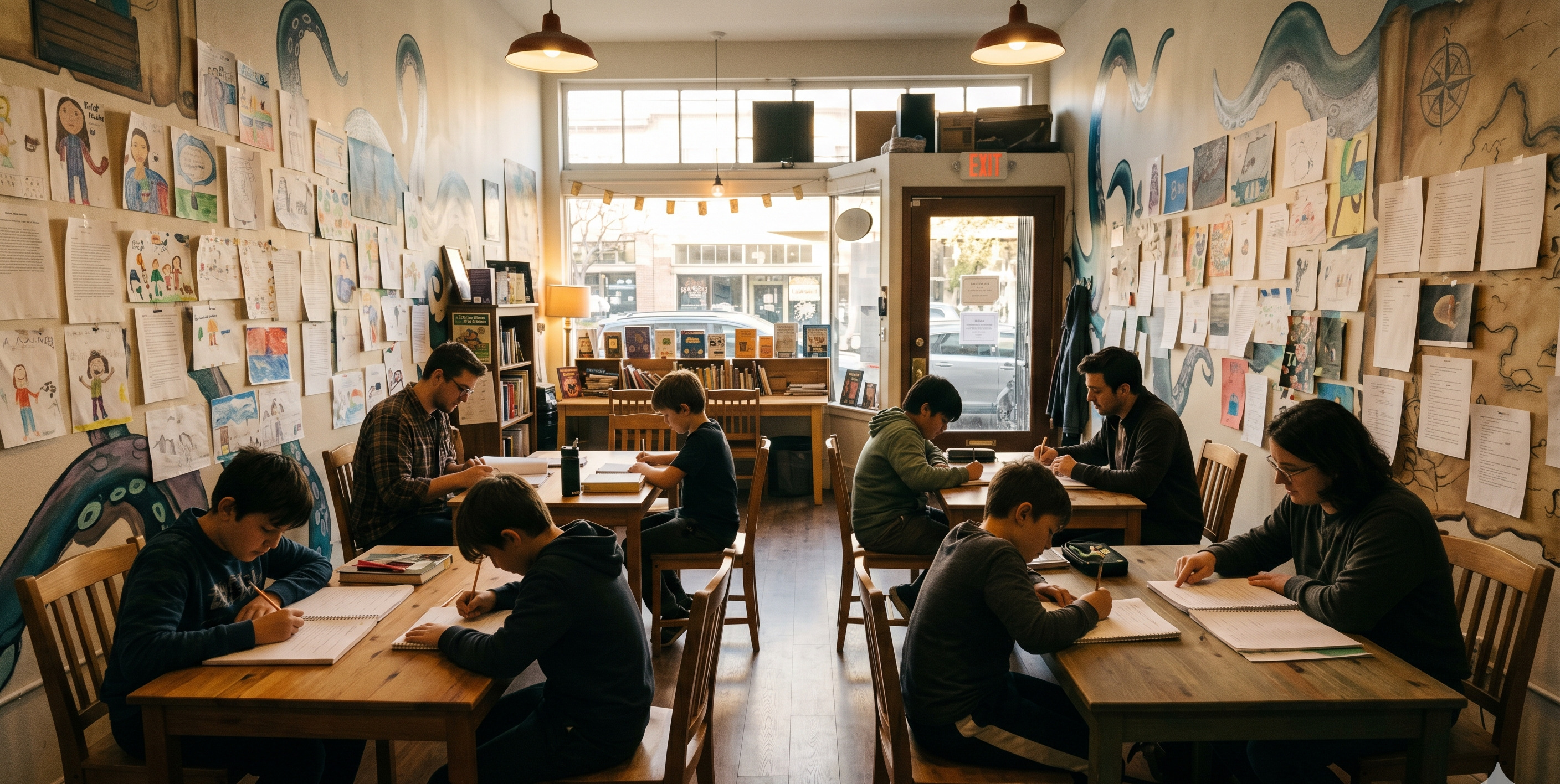
The kids come in at 3:15. They have been coming in at 3:15 since 2002. The table is the same oak slab. The chairs have been replaced three times. The rules on the wall have not changed since the year the room opened.
826 Valencia has been on Valencia between 18th and 19th since the program’s founding. The pirate shop out front is the famous part. The tutor room in the back is the part that matters. The current program director has run it since 2017. Before her, Jennifer ran it for nine years. Before Jennifer, the founders, Dave and Nínive, ran it for six. The director has changed three times. The room has not.
She grew up four blocks from here. She got tutored in this room in 2009, when she was fifteen and figuring out community-college transfer applications. She came back in 2015 as a volunteer, became a part-time coordinator in 2016, and took the director chair the year after. She has not left. She has been offered three jobs at larger organizations. She has turned down all three.
The math of staying small is the thesis of the room. The afternoon shift holds twenty-five kids. The volunteer-to-kid ratio is one to two on a good day, one to three on a stretched day, never higher. When demand spikes, she adds a waitlist. She does not add tables. The waitlist is the cost of the ratio. The ratio is the point.
The five rules on the wall, hand-lettered by a volunteer in 2003, have outlasted every program initiative anyone has tried to add. Show up on time. Bring your work. Ask for help. Help someone else when you finish. Leave the room cleaner than you found it. The kids read them once on their first day. After that the rules just run.
Last year the room helped 728 students with homework, college essays, and the kind of one-on-one explanation that classrooms cannot offer at scale. Twenty-three of last year’s seniors got into UC Berkeley. Eleven got into Stanford. Six chose community college because it was the right financial fit, and 826 helped them with that decision the same way it helped the others with their UC essays. The room does not measure success by which acceptance letter arrives. It measures success by whether the kid felt heard while they were figuring out which to send back.
The funding comes from the parent organization, which gets funded by individual donors. About sixty percent of the money is recurring monthly contributions of fifty dollars or less. The director names each of the named donors at the spring open house. She knows their first names. She knows what neighborhood they live in. She knows which ones got tutored here themselves twenty years ago and which ones just believe in the room because it works.
The piracy on the front side raises about eighteen percent of the budget. The director is not opposed to the pirate shop. She is also not interested in expanding it. The retail is the front door. The room is the building.
She did not want to be quoted talking about her own work. She wanted me to write about the volunteers instead. We compromised. I wrote about the room.
“The room works because nobody has tried to make it bigger. Bigger would mean fewer kids actually being heard. We are choosing to be small.”
PROGRAM DIRECTOR, 826 VALENCIA
WORK WITH THE KEEPERS
Partner packages
Sponsor a saturday, a profile, a season, or a year. Real editorial firewall.
Tell us your story
Operator, keeper, regular, kid with a paper route. Pitch us what you know.
Send a tip
Anonymous if you want. We chase every one we can verify.
We're hiring
Student journalism roles. Paid. SF or Bay Area. See the open list.
READ NEXT
ISSUE №58 · BY ERIC

Zareen's Opens a Fourth Kitchen
ISSUE №57 · BY DAISY
Olive Branch Roasters and the Two-Lot Theory of Coffee
ISSUE №56 · BY NICHOLAS
